CogAT Test Prep: A Parent's Guide
The CogAT (Cognitive Abilities Test) is a widely used gifted-program screening assessment. Unlike the visual-only NNAT, it measures reasoning in three areas — verbal, quantitative, and nonverbal — through nine short subtests. Levels follow age: Level 8 is the form most 2nd graders take. The biggest gift a parent can give is familiarity: a child who has seen a number puzzle or a paper-folding question before test day spends attention on reasoning instead of on decoding what the question wants.
The three batteries and nine subtests
Verbal Battery
Reasoning with words and, in early grades, with pictures that stand in for words.
- Picture/Verbal AnalogiesThis is to that — as this is to what?Explained with an example →
- Sentence CompletionChoose the picture or word that best completes the idea.Explained with an example →
- Picture/Verbal ClassificationWhich one belongs with the group — and which does not?Explained with an example →
Quantitative Battery
Reasoning with numbers, quantities, and relationships — not memorized arithmetic.
- Number AnalogiesSpot the numerical relationship, then apply it to a new pair.Explained with an example →
- Number PuzzlesBalance simple equations by finding the missing amount.Explained with an example →
- Number SeriesFind the rule in a sequence and predict what comes next.Explained with an example →
Nonverbal Battery
Reasoning with shapes and figures — the battery closest in spirit to the NNAT.
- Figure MatricesComplete the shape grid the way an analogy completes a sentence.Explained with an example →
- Paper FoldingPicture where the holes land when the folded paper is opened.Explained with an example →
- Figure ClassificationFind the figure that follows the same rule as the group.Explained with an example →
How to prepare, practically
- Short and varied beats long and repetitive. A few questions from different subtests each day keeps attention fresh at this age.
- Talk through answers. Asking "why is that one right?" builds the reasoning the assessment is looking for — in both directions.
- Don't skip the quantitative battery. It rewards number sense, not arithmetic drills — number series and puzzles feel like games when practiced early.
- Nonverbal overlaps with the NNAT. If your district uses either assessment, figure-matrix practice transfers well between them.
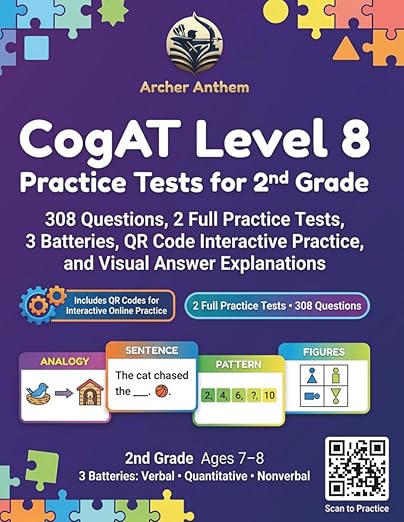
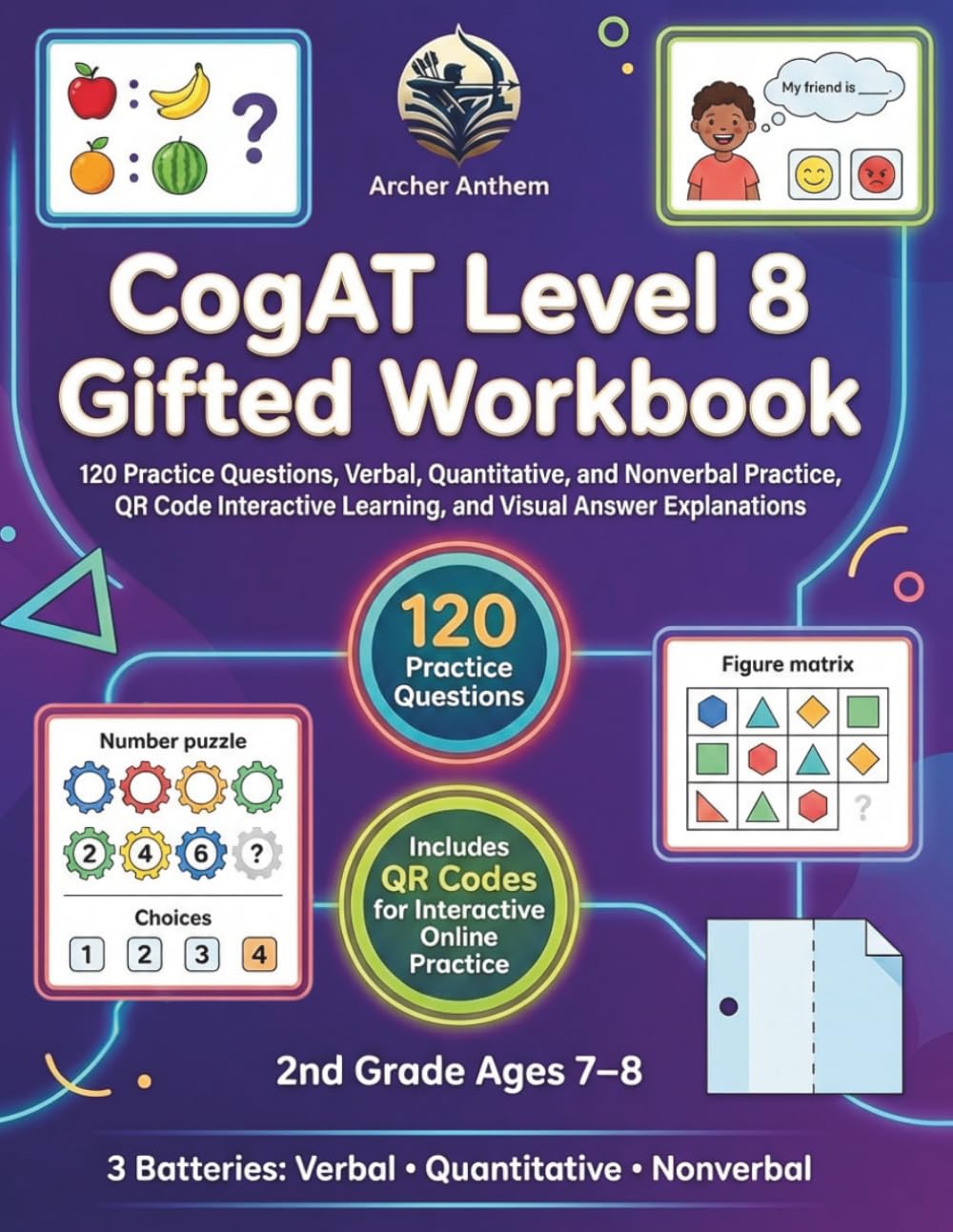
CogAT practice books by Archer Anthem
Related guides
Frequently asked questions
What is the CogAT?
The CogAT (Cognitive Abilities Test) is a reasoning assessment widely used for gifted program screening. Unlike the nonverbal-only NNAT, it measures three areas — verbal, quantitative, and nonverbal reasoning — through nine short subtests.
What is CogAT Level 8?
CogAT levels are named for student age, not grade: Level 8 is typically taken by 2nd graders (around age 8). Kindergarten students typically take Level 5/6, and 1st graders Level 7.
What are the nine CogAT subtests?
Verbal: Picture/Verbal Analogies, Sentence Completion, Picture/Verbal Classification. Quantitative: Number Analogies, Number Puzzles, Number Series. Nonverbal: Figure Matrices, Paper Folding, Figure Classification.
How long does the CogAT take?
Each battery runs roughly 30–45 minutes, usually given in separate sittings. Some districts administer all three batteries; others use a screening form with fewer questions.
How should a 2nd grader prepare for the CogAT?
Familiarity beats cramming: a child who has seen number analogies and paper-folding puzzles before test day spends attention on reasoning, not on decoding instructions. Short, varied practice across all nine formats works best.
How is the CogAT scored?
The headline number is the Standard Age Score (SAS), normed to a mean of 100 with a maximum of 160. Districts also see percentile ranks and a stanine profile per battery; gifted cutoffs vary by program.
Do these books cover the verbal and quantitative parts, not just shapes?
Yes. Unlike the nonverbal-only NNAT, our CogAT Level 8 practice covers all three batteries — Verbal, Quantitative, and Nonverbal — across all nine subtests, including picture analogies, sentence completion, number puzzles, number series, figure matrices, and paper folding.
Is CogAT practice paper or digital?
Print-first: the practice books are physical, done with pencil and paper the way the test is taken, with a QR code on each section that opens optional online practice and a visual answer key. The paper practice builds test-day stamina; the digital layer explains the tricky ones.
Get free printable practice samples
Sample pages from our practice books, delivered by email — see the question style before you buy anything.
Get free samplesNNAT® (Naglieri Nonverbal Ability Test®) is a registered trademark of Pearson Education, Inc. CogAT® (Cognitive Abilities Test™) is a registered trademark of Riverside Assessments, LLC. Neither Pearson nor Riverside is affiliated with, nor do they endorse, Archer Anthem. Archer Anthem materials are independent practice resources in the style of these assessments.