NNAT Test Prep: A Parent's Guide
The NNAT (Naglieri Nonverbal Ability Test) is one of the most common assessments schools use to screen young students for gifted and talented programs. It is entirely visual — shapes and patterns, no reading required — which makes it fair across language backgrounds, and also makes its question formats unfamiliar to most children the first time they see them. This guide explains what the assessment measures, what each level looks like, and how to build familiarity with practice.
NNAT levels by grade
Level A · Kindergarten
Mostly Pattern Completion with introductory analogies. Sessions should be short and encouraging — attention span matters more than technique at this age.
Level B · 1st Grade
Adds more Reasoning by Analogy and introduces Serial Reasoning. Children benefit from talking through why an answer is right.
Level C · 2nd Grade
All four question types appear, including Spatial Visualization. Timed practice starts to matter — pace without pressure.
The four NNAT question types — with real examples
Every example below is an actual Archer Anthem practice question with its visual answer explanation — the same style of material used throughout our practice books and free interactive samples.
Pattern Completion
Deep dive: Pattern Completion explained →A design has a missing piece. Your child looks at the whole pattern and picks the answer tile that completes it — checkerboards, stripes, and rotations are common.
Parent tip: Ask your child to describe the pattern out loud before choosing — naming the rule (“it alternates”) is most of the work.
Try it: Pattern Completion (Level C practice question — tap an answer)
Show the answer and explanation
Answer: C
The pattern is divided into four quadrants with different fill colors. The missing piece should match the quadrant color and central shape.
Reasoning by Analogy
Deep dive: Reasoning by Analogy explained →A grid shows shapes that change across a row — bigger, rotated, recolored. Your child works out the relationship and applies the same change to a new shape.
Parent tip: Practice the phrase “A is to B as C is to …” — it turns a picture puzzle into a sentence a child can finish.
Try it: Reasoning by Analogy (Level C practice question — tap an answer)
Show the answer and explanation
Answer: D
In each row, the shapes rotate 90° clockwise (vertical becomes horizontal) and filled shapes become outlined while outlined shapes become filled.
Serial Reasoning
Deep dive: Serial Reasoning explained →Shapes change step by step across a sequence. Your child finds what comes next by spotting how each step differs from the one before.
Parent tip: Cover the answer choices first — predicting before peeking builds the reasoning habit instead of elimination guessing.
Try it: Serial Reasoning (Level C practice question — tap an answer)
Show the answer and explanation
Answer: B
Each square gets progressively lighter from left to right. The missing piece should be the lightest square.
Spatial Visualization
Deep dive: Spatial Visualization explained →The hardest family: your child mentally combines, folds, or rotates shapes and picks the result — the kind of thinking used in geometry years later.
Parent tip: These improve fastest with short, repeated exposure. A few questions a day beats a long weekend session.
Try it: Spatial Visualization (Level C practice question — tap an answer)
Show the answer and explanation
Answer: D
In each row, the shapes at positions 3 and 2 swap while the shape at position 1 stays in place. The missing piece shows the swapped arrangement.
Free interactive NNAT practice
Each free sample set below runs in the browser with instant feedback and visual explanations — the same interactive practice our printed books link to by QR code.
Want printable samples by email? Get free samples →
NNAT practice books by Archer Anthem
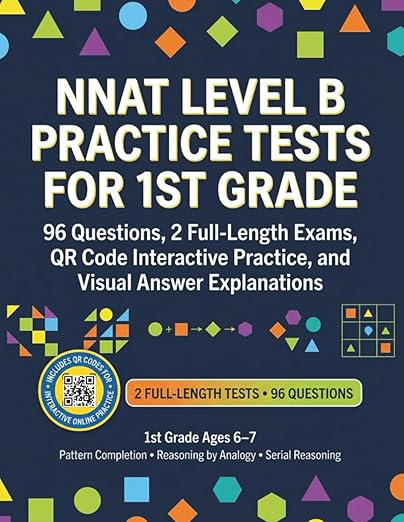
NNAT Level B Practice Tests for 1st Grade
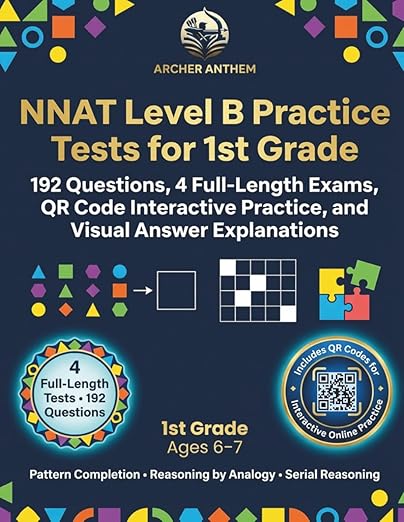
NNAT Level B Practice Tests for 1st Grade
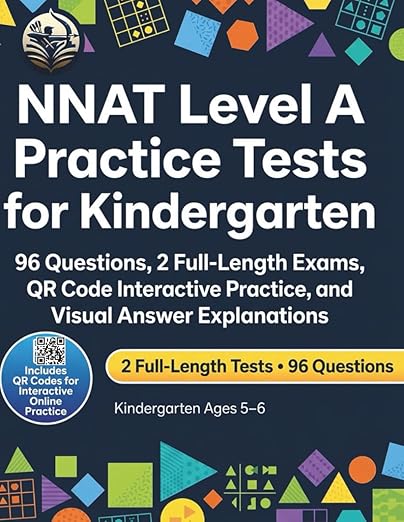
NNAT Level A Practice Tests for Kindergarten
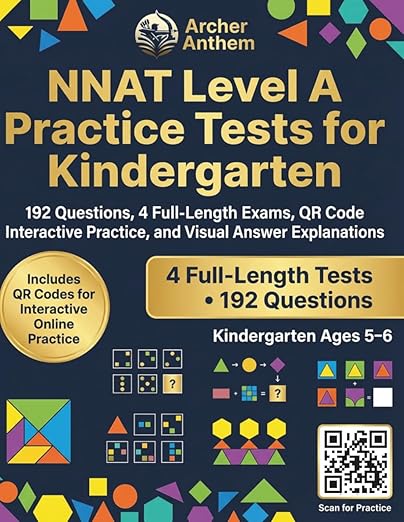
NNAT Level A Practice Tests for Kindergarten
NNAT Level C Practice Tests for 2nd Grade
NNAT Level C Practice Tests for 2nd Grade
Related guides
Frequently asked questions
What is the NNAT?
The NNAT (Naglieri Nonverbal Ability Test) is a nonverbal reasoning assessment schools commonly use to screen students for gifted and talented programs. Because it uses shapes and patterns rather than words, it is considered fair for children regardless of language background.
What does the NNAT measure?
General reasoning ability expressed visually: recognizing patterns, spotting relationships between shapes, and predicting what comes next. It does not test reading, vocabulary, or math facts.
Which NNAT level will my child take?
Levels follow grade: Level A for Kindergarten, Level B for 1st grade, Level C for 2nd grade, and higher levels beyond. Your school district confirms the exact level and testing window.
How many questions are on the NNAT?
A full administration is 48 questions with roughly 30 minutes of testing time. That pacing — under a minute per question — is why familiarity with the question formats helps.
Is the NNAT an IQ test?
Not exactly. It estimates nonverbal general ability, which correlates with IQ measures, but schools use it as a screening tool rather than a clinical IQ assessment.
How should a parent help a child prepare?
Short, regular practice with the four question formats — Pattern Completion, Reasoning by Analogy, Serial Reasoning, and Spatial Visualization — so nothing about the format is surprising on test day. Practice materials build familiarity and confidence; no preparation can or should promise a specific score.
What is a good NNAT score?
Results are reported as the Naglieri Ability Index (NAI), normed to a mean of 100. Many gifted programs look for scores in the 120s or higher, but cutoffs vary by district — check your program's published criteria.
Is this paper practice or digital?
Both, in that order. Our practice books are physical, pencil-and-paper — the same way the test is usually taken — so your child builds genuine test-day stamina on paper. A QR code on each section then opens the same questions as optional online practice with a visual answer key, so digital is a supplement, not the main event.
How do the visual answer explanations work?
Instead of a letter and a paragraph a young child can't read, the correct piece is shown gliding back into the puzzle grid — so your child sees it fit, and sees why each wrong option doesn't. It teaches the reasoning independently, which is the whole point of nonverbal practice.
Will this stress out a young child?
It's designed not to. The pages look and feel like brain-game puzzles rather than a rigid exam, which keeps a 4–7 year old engaged and confident instead of anxious — the familiarity is what reduces test-day nerves.
Start with free NNAT-style practice
Try the interactive sample questions for your child's level — no signup needed — or get printable samples by email.
Free NNAT practiceNNAT® (Naglieri Nonverbal Ability Test®) is a registered trademark of Pearson Education, Inc. CogAT® (Cognitive Abilities Test™) is a registered trademark of Riverside Assessments, LLC. Neither Pearson nor Riverside is affiliated with, nor do they endorse, Archer Anthem. Archer Anthem materials are independent practice resources in the style of these assessments.