Whole Number Operations
Learn More · ID: 814176A1
Multi-digit multiplication and division are like solving puzzles using the basic math facts you already know! Instead of being scared of big numbers, we break them down into smaller, easier pieces. Think of it like building with blocks - you use small blocks to create something much bigger and more impressive.
Tip
Always estimate your answer first! For 34 × 12, think: 30 × 10 = 300, so your answer should be close to 300. This helps you catch mistakes.
Mastering Multi-Digit Operations · 1:12
Tip
Multi-digit multiplication is just doing several smaller multiplications and adding them together. Multi-digit division is like sharing equally into groups, one digit at a time.
Worked Example
Problem
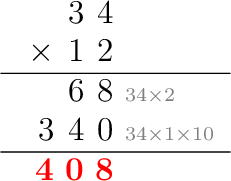
Find 34 × 12
Solution
408
Explanation
- 1Set up the problem vertically with 34 on top and 12 below.
- 2Multiply 34 × 2 (the ones digit). 4 × 2 = 8, write 8. 3 × 2 = 6, write 6. This gives us 68.
- 3Multiply 34 × 10 (the tens digit). 4 × 1 = 4, but since this is in the tens place, write 40. 3 × 1 = 3, but in the tens place this becomes 300. This gives us 340.
- 4Add the partial products: 68 + 340 = 408.
- 5Check by estimating: 30 × 10 = 300, and 408 is close to 300, so our answer makes sense!
Worked Example
Problem
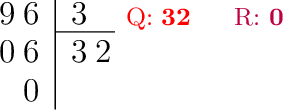
Find 96 ÷ 3
Solution
32
Explanation
- 1Set up long division with 96 inside the division box and 3 outside.
- 2Look at the first digit, 9. Ask: How many times does 3 go into 9? 3 × 3 = 9, so write 3 above the 9.
- 3Multiply 3 × 3 = 9, write it under the 9, and subtract: 9 - 9 = 0.
- 4Bring down the next digit, 6. Now ask: How many times does 3 go into 6? 3 × 2 = 6, so write 2 above the 6.
- 5Multiply 3 × 2 = 6, write it under the 6, and subtract: 6 - 6 = 0.
- 6Since there are no more digits and no remainder, the answer is 32.
Question
A school is ordering 12 boxes of pencils. Each box contains 24 pencils. How many pencils will they have in total?
Show Answer
Show Solution
- 1This is asking for 12 × 24. Set up the multiplication vertically with 24 on top and 12 below.
- 2First, multiply 24 × 2 (the ones digit of 12). 4 × 2 = 8, write 8. 2 × 2 = 4, write 4. This gives us 48.
- 3Next, multiply 24 × 10 (the tens digit of 12). 4 × 1 = 4, but since this is the tens place, it's really 40. 2 × 1 = 2, but in the tens place this becomes 200. This gives us 240.
- 4Add the partial products: 48 + 240 = 288.
- 5Check by estimating: 10 × 20 = 200, and 288 is reasonably close to 200, so our answer makes sense! The school will have 288 pencils total.
Tip
Remember: Big multiplication and division problems are just combinations of the basic facts you already know. Break them into smaller steps, estimate first, and check your work. You've got this!